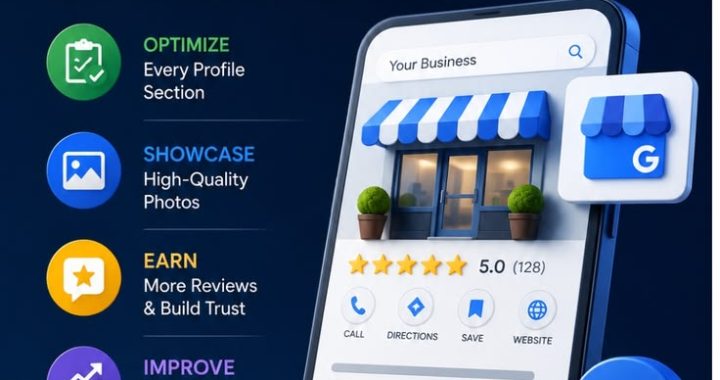
Optimizing Your Google Business Profile for Higher Local Visibility
They’ll search something like “coffee shop near me” or “plumber in [city],” and Google will serve up a map with three highlighted listings — commonly known as the Local Pack. Whether your business shows up in that coveted three-pack often comes down to one thing: how well your Google Business Profile (GBP) is optimized.
A Google Business Profile is free, but it’s far from a “set it and forget it” tool. Businesses that treat it as a living, breathing part of their marketing strategy consistently outrank those that fill it out once and never touch it again. In this post, we’ll walk through exactly what it takes to turn your profile into a local visibility magnet.
Local search is where buying decisions are made. People searching with local intent — “near me,” a city name, or a neighborhood — are usually further along in the decision-making process than someone doing general research. They’re ready to call, visit, or book. Your GBP is often the first (and sometimes only) impression a potential customer gets before deciding whether to choose you or the business next door.
Beyond visibility in the Local Pack, your profile also influences:
Google Maps rankings, which matter enormously for mobile users on the go
Trust and credibility, since a complete, active profile signals a legitimate, well-run business
Click-through rates, because photos, reviews, and posts give searchers a reason to choose you before they even visit your site

In short, an optimized profile doesn’t just help people find you — it helps convince them to choose you.
1. Get Your Business Information Complete and Accurate
This sounds obvious, but incomplete listings are one of the most common reasons businesses underperform locally. Google rewards profiles that are thorough because a complete listing gives both users and Google’s algorithm more confidence in the business.
Make sure the following are filled out and kept current:
Business name — use your real-world name exactly as it appears on your signage; don’t stuff keywords into it
Address — precise and matching what’s on your website and other directories
Phone number — a local number performs better than a toll-free one
Website URL
Business hours, including holiday hours, which should be updated seasonally
Consistency is the key theme here. Your Name, Address, and Phone number (commonly referred to as NAP) should match exactly across your website, social profiles, and any online directories. Even small discrepancies — like “St.” versus “Street” — can create confusion for Google and weaken your local ranking signals over time.
2. Choose the Right Categories
Categories are one of the most heavily weighted ranking factors for local search, yet they’re frequently overlooked. Your primary category should describe your core business as precisely as possible — a “Mexican Restaurant” is a stronger signal than the generic “Restaurant” if that’s genuinely your specialty.
A few tips for category selection:
Pick a primary category that’s as specific as possible to your main offering
Add secondary categories for other relevant services, but avoid categories that don’t genuinely apply
Periodically review your categories, since Google adds new, more specific options over time
Avoid keyword-stuffing into your business name to compensate for weak categories — this violates Google’s guidelines and can get your listing suspended
3. Use High-Quality Photos and Videos
Visual content plays a bigger role in local search than most business owners realize. Photos help potential customers picture themselves walking through your door, and they build trust before a single word is exchanged.
Aim to regularly upload:
Exterior shots so people can recognize your location when they arrive
Interior photos that showcase the atmosphere or workspace
Team photos, which humanize your business and build familiarity
Product or service photos that show exactly what customers can expect
Short videos, which tend to stand out more in a sea of static images
Freshness matters too. Businesses that add new photos regularly tend to appear more active and engaged, which is a positive signal both for users and for Google’s ranking algorithm.
4. Actively Manage Reviews
Reviews are arguably the single most persuasive element of your entire profile. They influence both rankings and, just as importantly, whether a searcher chooses to click through and contact you at all.
Here’s how to make reviews work in your favor:
Ask for them consistently. Don’t rely on customers to think of it themselves — build a simple, low-friction ask into your service process.
Respond to every review, positive or negative. A thoughtful reply shows you’re engaged and care about the customer experience.
Handle negative reviews professionally. Acknowledge the concern, avoid being defensive, and offer to resolve the issue offline when appropriate.
Never buy or fake reviews. Google’s detection systems have gotten sophisticated, and getting caught can lead to profile suspension.
Use keywords naturally when responding, mentioning your service or location where it fits organically — this can reinforce relevance signals over time.
The quantity, recency, and overall sentiment of your reviews all factor into your local ranking, so treat review generation as an ongoing process rather than a one-time push.
5. Post Regularly Using Google Posts
Many business owners don’t realize that Google Business Profile includes a built-in posting feature, similar to a mini social media feed that appears directly on your listing. Posts can highlight promotions, events, new products, or general updates.
Consistent posting signals to Google that your business is active and engaged, which can positively influence visibility.It also gives potential customers fresh reasons to choose you over a competitor whose listing hasn’t changed in months
A few ideas worth posting regularly:
Seasonal promotions or limited-time offers
New product or service announcements
Behind-the-scenes glimpses of your team or process
Answers to common customer questions
Upcoming events or community involvement
6. Fill Out the Q&A Section Proactively
Left unmanaged, this section can end up with outdated or even incorrect information from random users.
Take control by:
Seeding the section yourself with the questions customers most frequently ask
Monitoring it regularly so you can respond quickly to new questions
Providing clear, helpful answers that double as an opportunity to reinforce key information (hours, services, parking, accessibility, etc.)
7. Leverage Attributes and Services
Attributes are the small details that help your listing stand out for specific searches — think “wheelchair accessible,” “outdoor seating,” “free Wi-Fi,” or “women-owned.” These may seem minor, but they help match your business to more specific search queries and give customers extra confidence before they visit.
Similarly, the Services or Products section lets you list exactly what you offer, complete with descriptions and pricing if you choose. This not only helps customers understand your offerings at a glance but also gives Google more contextual data to match your listing with relevant searches.
8. Keep an Eye on Insights
Google Business Profile provides built-in analytics showing how customers are finding and interacting with your listing — including how they searched, what actions they took, and where they’re viewing you from. Reviewing these insights regularly helps you understand what’s working and where there’s room to improve, whether that means adjusting your categories, posting more often, or focusing on review generation.
Bringing It All Together
Optimizing your Google Business Profile isn’t a one-and-done task — it’s an ongoing part of your local marketing strategy that deserves the same attention as your website or social media. The businesses that consistently show up at the top of local search results are almost always the ones actively managing every element of their profile: accurate information, strong categories, fresh photos, a steady stream of reviews, and regular posts.
The good news is that none of this requires a big budget — just consistency and attention to detail. Start with the fundamentals (accuracy and categories), build momentum with reviews and photos, and layer in posts and Q&A management as ongoing habits. Over time, these small, consistent efforts compound into meaningfully better local visibility — and more customers walking through your door because they found you first.